
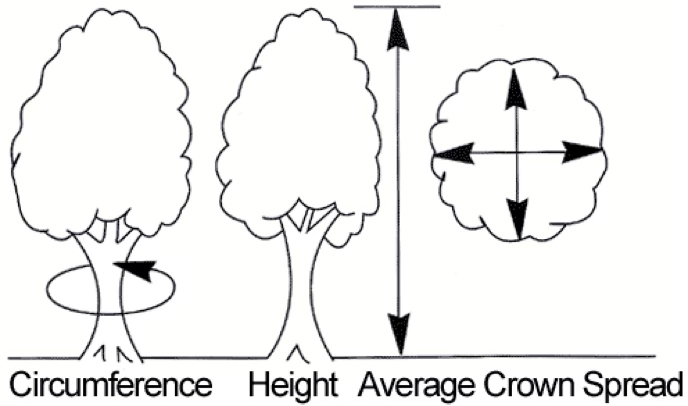
Fred Besley, Maryland’s first forester, developed the formula used today to measure trees: Circumference in inches + Height in feet + ¼ of the average crown spread = TOTAL POINTS
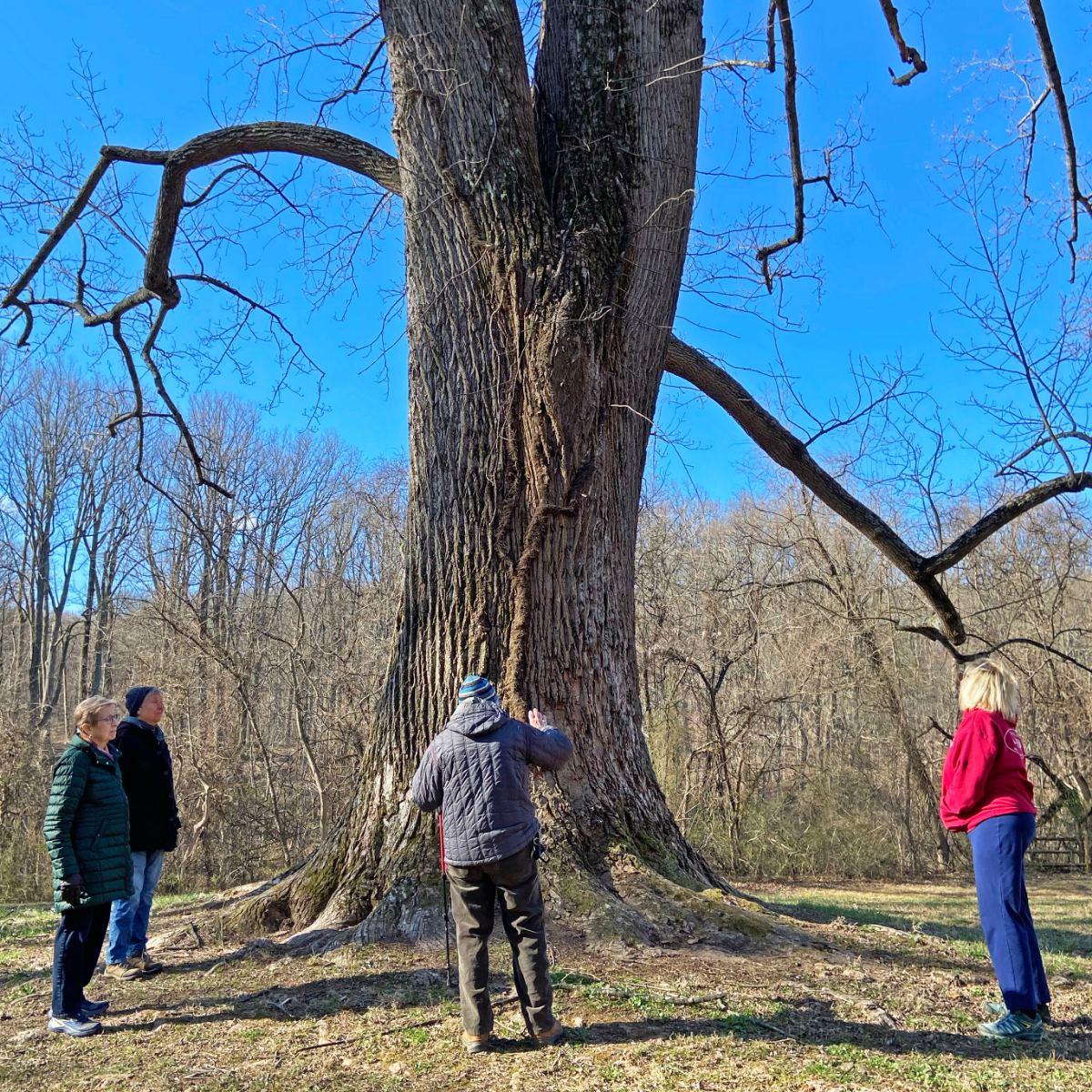
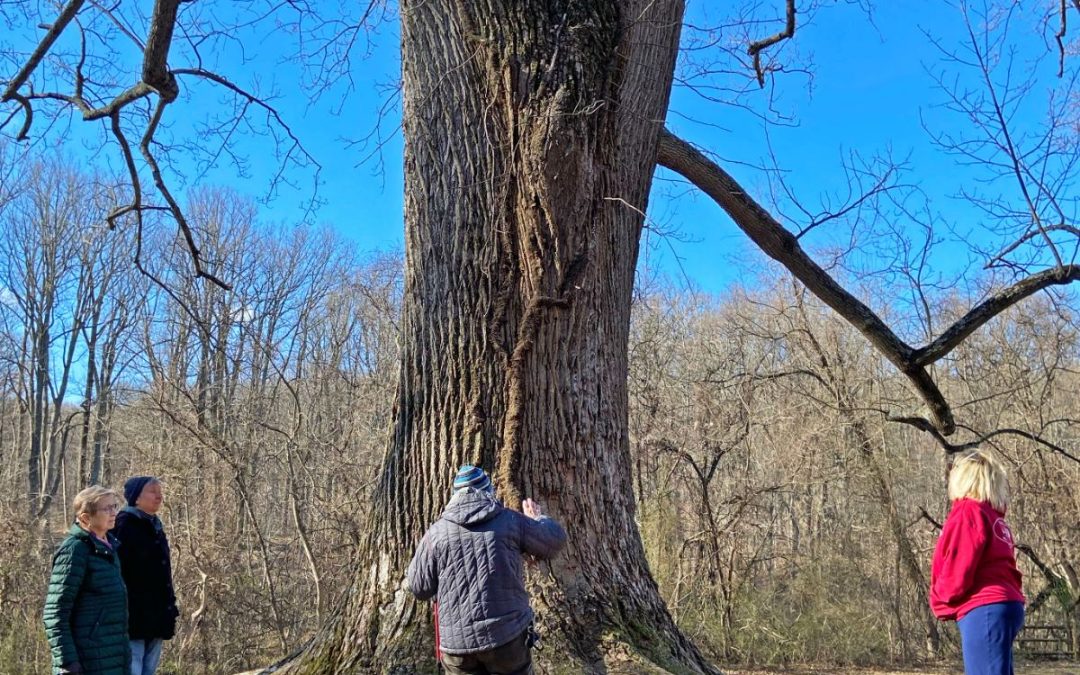
The Friends of Oregon Ridge Senior Stroll Program participants stopped to visit Big Tree BT-3159 a Yellow-Poplar / Tuliptree (225″ Circumference; 122′ Height; 105′ Spread).
Judy Breitenbach, Maryland Master Naturalist
In 1634, Maryland was almost 95% forested (Seeing the Forest through the Trees). As the State was inhabited by colonists, wood was considered a commodity and used for building homes, firewood, etc. Trees were cleared for crop production. As time progressed and land ownership changed from public domain to private ownership, more forests were devastated because of their overuse, followed by abandonment without any plans for their regrowth (Buckley, G.L., and Grove, J. Morgan, Maryland Historical Magazine, VOL. 96. NO. 3, Fall 2001). Per Buckley and Morgan, “lumber production increased dramatically between 1850 and 1910 from 5.4 billion board feet to 44.5 billion board feet per year, a rate more than double the rate of population growth.”
It was not until the 1890s that the United States established a true interest in forest sustainability. In 1891, President Benjamin Harrison established the first forest reserve – Yellowstone Park Timber Reserve. Additional acreage was set aside by 1897, when the program was then referred to as national forests. Gifford Pinchot was named the Chief Forester of the United States Department of Agriculture. Pinchot implemented a scientific approach to forest management, which included the investigation of “forest fire and its consequences, tree planting problems and reforestation, development for forest waste materials, and conducted investigations in the chemistry of maple sugar, tree diseases, and the method of extracting turpentine.” (Buckley and Morgan, 2001).
Maryland became the third State of the Union to invest in forest land in 1906 by establishing the State Board of Forestry and drafting the Maryland Forestry Conservation Act. The intent was for the Board to “protect and manage the state forests and parks” and help landowners to “manage their timber resources” (Robert Bailey and Francis Zumbrun, Forest History Today, Spring / Fall 2005). Fred Besley, who worked with Gifford Pinchot, was named Maryland’s first state forester and served in that position from 1906 until 1942. During his tenure, he promoted and invested in Maryland’s public forest and park lands, expanding them from just 1,917 acres in 1906 to 117,000 acres at his retirement (Bailey and Zumbrun, 2005). Besley was also responsible for the establishment of a fire watchtower system across the State, along with protocols for fighting and controlling forest fires, and hiring “over 300 fire wardens” (Bailey and Zumbrun, 2005). He taught courses at the University of Maryland and enforced the nation’s first Roadside Tree Law. In 1916, he published The Forests of Maryland, the cataloging and mapping of every five-acre or greater tree area across Maryland. His commitment to forest conservation also included promoting its usefulness for recreational purposes, particularly camping, as evidenced by the establishment of the Patapsco Forest Reserve. A MPT/PBS profile of Besley can be accessed here.
Another prominent contribution was Besley’s data collection of Maryland’s tree size for individual species. For a number of years, he independently calculated the size of trees based upon trunk circumference, crown spread and height. In 1925, he started the “Maryland Big Tree Champion” contest. The Big Tree Champion program expanded to the national level in 1940.
Today, the Maryland Big Tree Program operates as a fully volunteer-based program within the Maryland State Association of Forest Conservancy District Boards (since 2007). There is a Forest Board for each county and the city. The program “is funded by a grant from the U.S. Department of Agriculture – Forest Service – for Urban and Community Programming…” https://www.marylandforestryfoundation.org/programs/big-tree-program/.
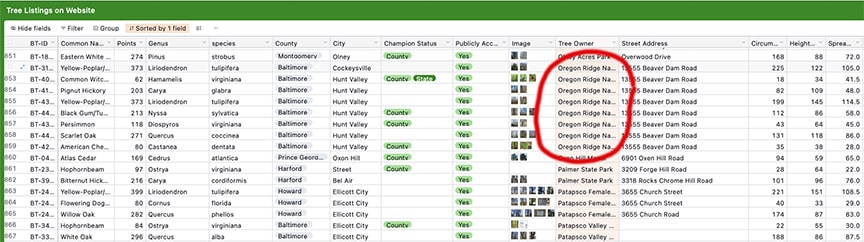
In April, the MBTP program marked its 100th anniversary in operation. A new website was developed in 2017, which contains an electronic database, which is accessible here. The database currently identifies 2,875 big trees throughout the State. The screenshot provided highlights the eight big trees located within Oregon Ridge Park/Nature Center. The Friends of Oregon Ridge is in the process of organizing guided hikes to seek out the trees during the fall months.
In the meantime, the MBTP is holding a Big Tree Centennial Contest over the summer. Its purpose is to engage the public in learning more about the historical importance of forest conservation and identifying additional big trees to add to the database. These links will provide you with additional information about the contest: